Chapter 02 of 091806 to 1860
Settlers on Knob Creek
Revolutionary veterans, a Baptist preacher named Hanks, a congregation that argued its way into the missionary camp, and the enslaved people whose labor the new farms relied on.
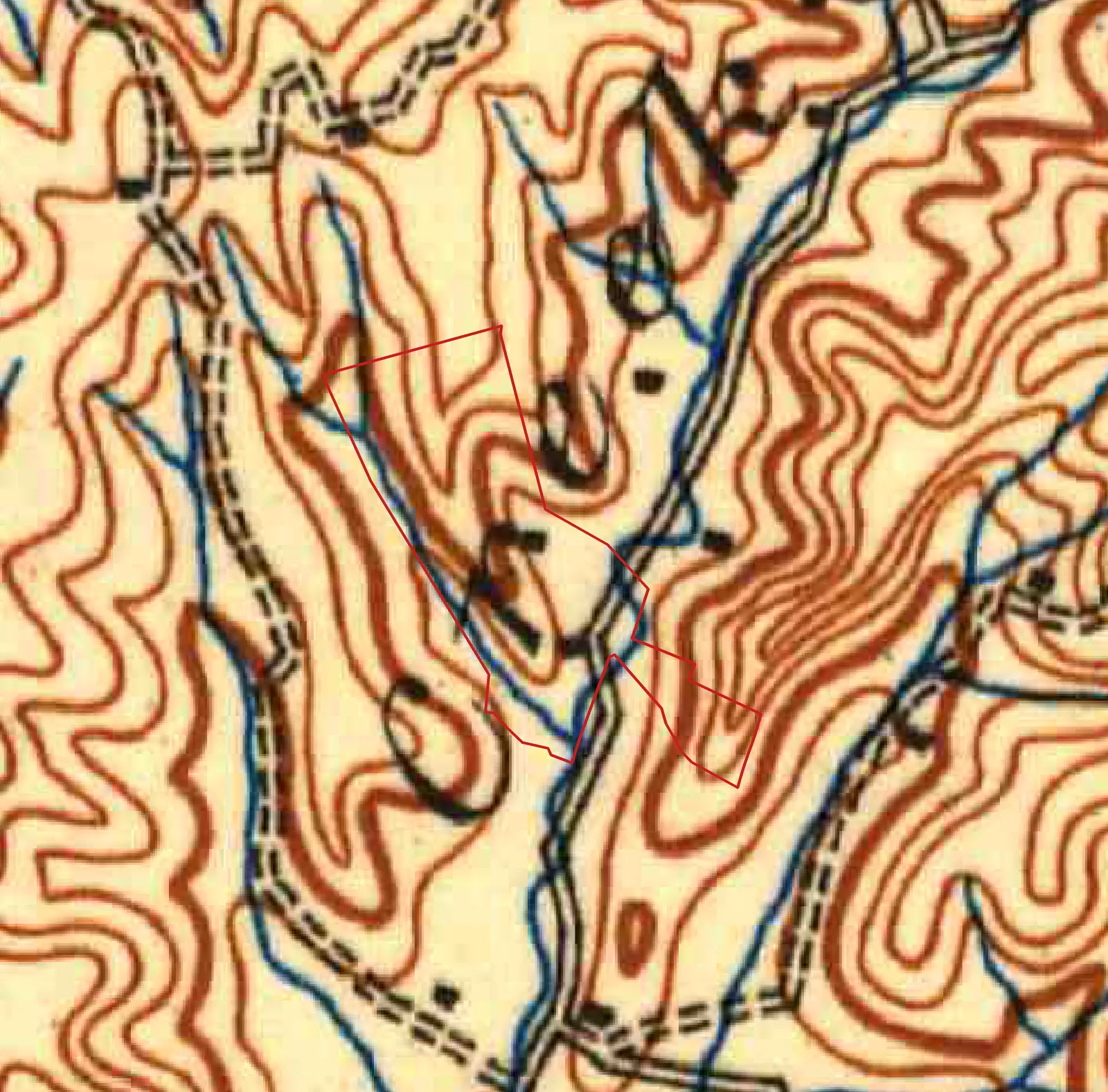
Columbia, Tenn. 1:125,000 quadrangle (detail, parcel outline added). U.S. Geological Survey · USGS Historical Topographic Map Collection (topoView) · 1901 · Public domain (U.S. federal government work)
Within a few years of the treaties, families were following Knob Creek up from the Duck River. They came mostly from Virginia and the Carolinas, often by way of Kentucky, looking for the rich limestone land they had heard about. Many held, or bought, land warrants that North Carolina had promised its soldiers during the Revolution.
The Whitsons and the Witherspoons
One of those soldiers was William Whitson, an officer in the Burke County, North Carolina, militia during the Revolution. In 1783 he received certificates for land that included ground on the Duck River. Between 1804 and 1806 he sold his North Carolina property and moved west. He died in 1806, and his will is the first recorded in Maury County's will books.
His daughter Sarah, called Sally, married Thomas Wesley Witherspoon. The Witherspoons became one of the families most tied to Knob Creek. Their family burying ground on the creek, the Old Knob Creek Cemetery, is also called the Witherspoon cemetery. Generations later, at least one of the Hendleys, the farm's longtime owners, carried "Witherspoon" as a middle name. How that name passed into the Hendley family has not been traced.
The preacher
In 1810 a family named Hanks arrived in Tennessee from Kentucky. They had come from Pittsylvania County, Virginia. The father, Moses Hanks, had been born around 1746 in Richmond County, Virginia. His son Elijah, born in 1793, married Mary "Polly" Woolverton in Maury County in June 1811.
Elijah Hanks became a Baptist preacher, and Knob Creek became his church. According to a memoir written after his death, the congregation began as an "arm," a branch, of the Rutherford's Creek church and later stood on its own. Church tradition dates its first gathering to about 1806 and its organization as an independent church to 1826. Hanks served as its pastor for more than thirty years.
He was not a quiet pastor. Around 1829 the Cumberland Association of Baptist churches cut off Hanks and two congregations, Knob Creek and Friendship, because he preached that Christ died for everyone, not only for a chosen few. The churches joined the Duck River Association instead. When that association split over missions in 1834, Knob Creek sided with the missionary Baptists. In 1849 Hanks helped found the Judson Association and served as its first moderator.
a free and full atonement
Moses Hanks died on August 19, 1831, and was buried in the old cemetery on Knob Creek. Elijah died in 1871 at the home of his son-in-law, John McDowell Witherspoon, and was buried there too. The two families, preacher and settler, had joined by marriage.
The Lincoln theory
Hanks family researchers have long wondered whether Moses Hanks was related to Nancy Hanks Lincoln, Abraham Lincoln's mother. Some family trees chart him as her uncle.
It is a theory, not a fact. Moses is said to descend from a Hanks line in the same Virginia parish as Joseph Hanks and Ann Lee, usually named as Nancy's grandparents. But Moses does not appear among Joseph's listed children, so if he was kin, he was more likely a cousin. A 2015 DNA study traced Nancy's mother's line back to Ann Lee, which settled one old argument. Nancy's father has never been identified. The tie to Lincoln may be real, but it cannot be proven from the records we have.
There is a pleasant coincidence either way. Lincoln spent part of his boyhood on a different Knob Creek, in Kentucky.
The people who were not free
The new farms of Maury County were built in large part by enslaved people. By 1860 the county had 32,498 residents, and 14,654 of them, about 45 percent, were enslaved. That share was far above the state's, which was just under a quarter.
The Knob Creek families were part of that system. When William Whitson's widow, Anne, made her will in 1827, she named thirteen enslaved people. To her daughter Sally Witherspoon she left two girls, Sarah and Mary, and a half share in a third, Margaret Jane. The 1872 memoir of Elijah Hanks mentions "the servants" at his wife's deathbed in 1854. They were very likely enslaved, though the memoir does not say so.
Their names rarely appear in the records that survive, and when they do, it is in wills and inventories that counted them as property. The Maury County Archives holds about 150 court documents on slavery from about 1810 to 1865, a starting place for anyone who wants to learn more about the people who lived and worked in this valley.
A neighborhood takes shape
By mid-century the valley had the bones of a community: the church, family burying grounds, a road along the creek. Just up Knob Creek Road from the farm, an endangered family cemetery for the Fitzgerald family sits behind a small house, its last known burial around 1903. Up the Theta road stood the New Hope school. Santa Fe, to the southwest, had its own post office by 1849, and Theta, just north, had one from 1882 to 1903.
Who owned the hollow that is now the farm in these years is still unknown. That answer waits in the deed books.
- 1783North Carolina officer William Whitson receives land certificates that include Duck River land.
- About 1806Whitson moves his family to the new country. His will becomes the first in Maury County's will books.
- About 1806Church tradition dates the first Baptist gathering on Knob Creek to about now.
- 1810The Hanks family arrives in Tennessee from Kentucky.
- 1826The traditional date for Knob Creek's organization as its own church.
- About 1829The Cumberland Association cuts off Elijah Hanks and Knob Creek over his views on salvation.
- 1831Moses Hanks, born in Virginia around 1746, dies and is buried on Knob Creek.
- 1834The Duck River Association splits over missions. Knob Creek goes with the missionary side.
- 1849Elijah Hanks is the first moderator of the new Judson Association.
- 1860Enslaved people make up about 45 percent of Maury County's population.
1807 to 1860
A town on the Duck River
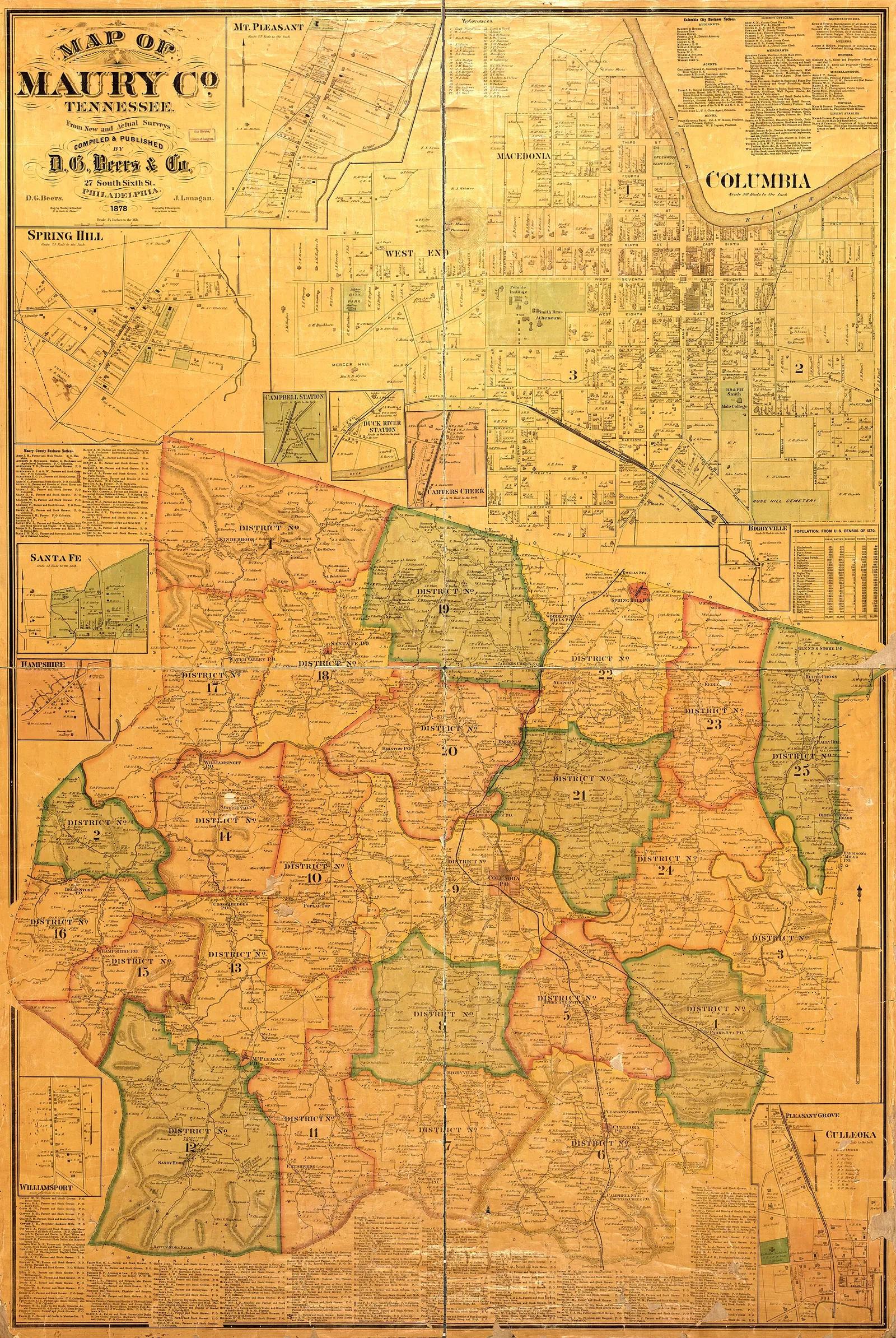
Columbia began as a plan on paper. In November 1807 the Tennessee General Assembly carved Maury County out of Williamson and Dickson counties and named it for Abram Maury, a state senator from Franklin. The next year the new county seat was laid out on the south bank of the Duck River, and its first lots were sold. The whole town was four square blocks.
It filled in quickly. The first courthouse went up on the square in 1809. Columbia was incorporated in 1817. By then the land around it was some of the richest in Tennessee: deep limestone soil, good springs, and a river that could carry goods downstream. Settlers grew cotton and tobacco and raised horses, mules, cattle and hogs. Before the Civil War, Maury County ranked near the top of the state in wealth.
The Polks
One family shaped the town's story more than any other. The Polks came from Mecklenburg County, North Carolina, in 1806, the year before the county existed. Young James Knox Polk went to the common schools here, then to the University of North Carolina. He came back to Columbia to practice law in 1820.
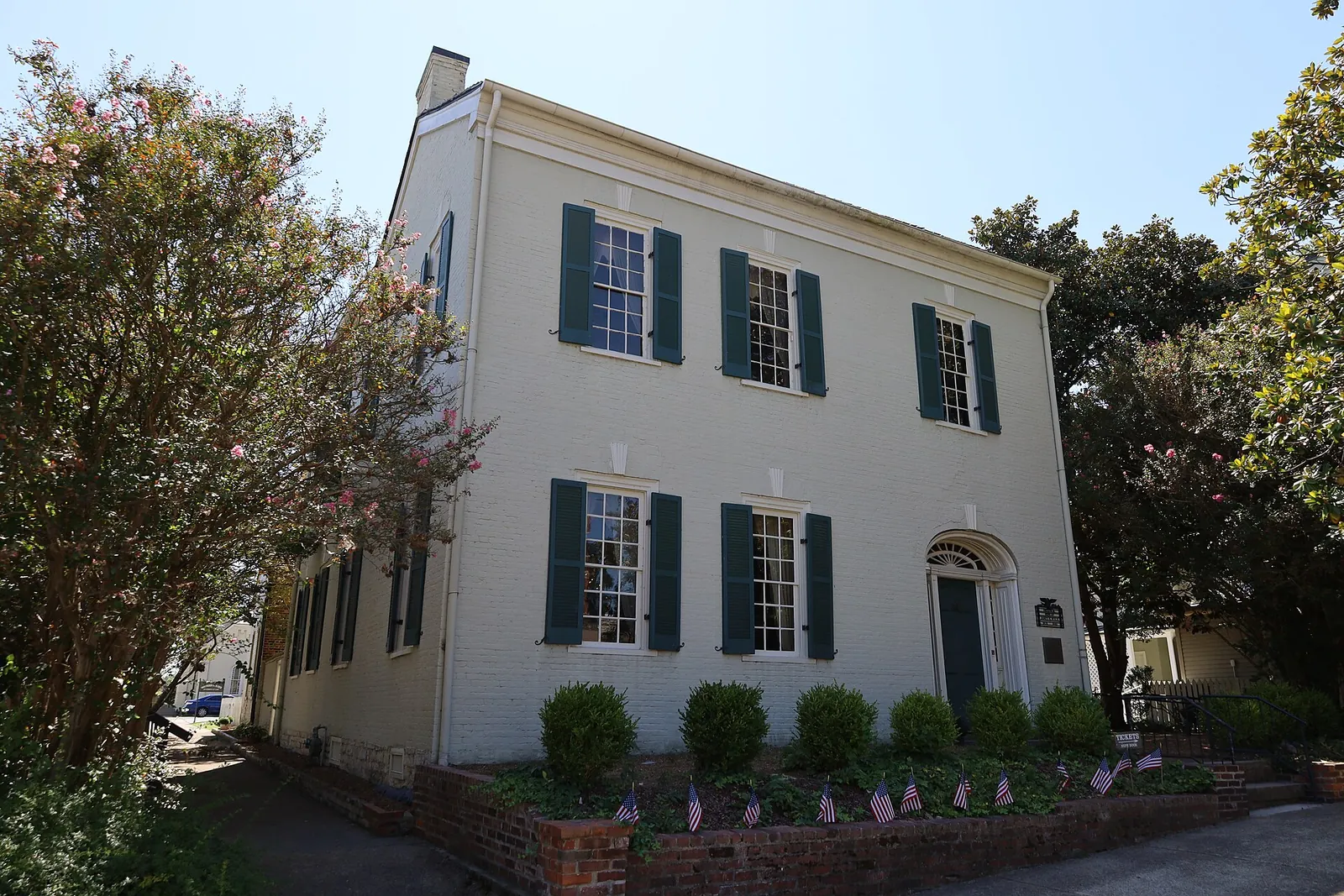
The family's brick house on West 7th Street was built in 1816, and James lived there as a young lawyer until he married Sarah Childress. From that office he went to the Tennessee House, then to Congress for fourteen years, the last four as Speaker. He was governor from 1839 to 1841 and president from 1845 to 1849. Apart from the White House, the Columbia house is the only home of his that still stands.
 Now
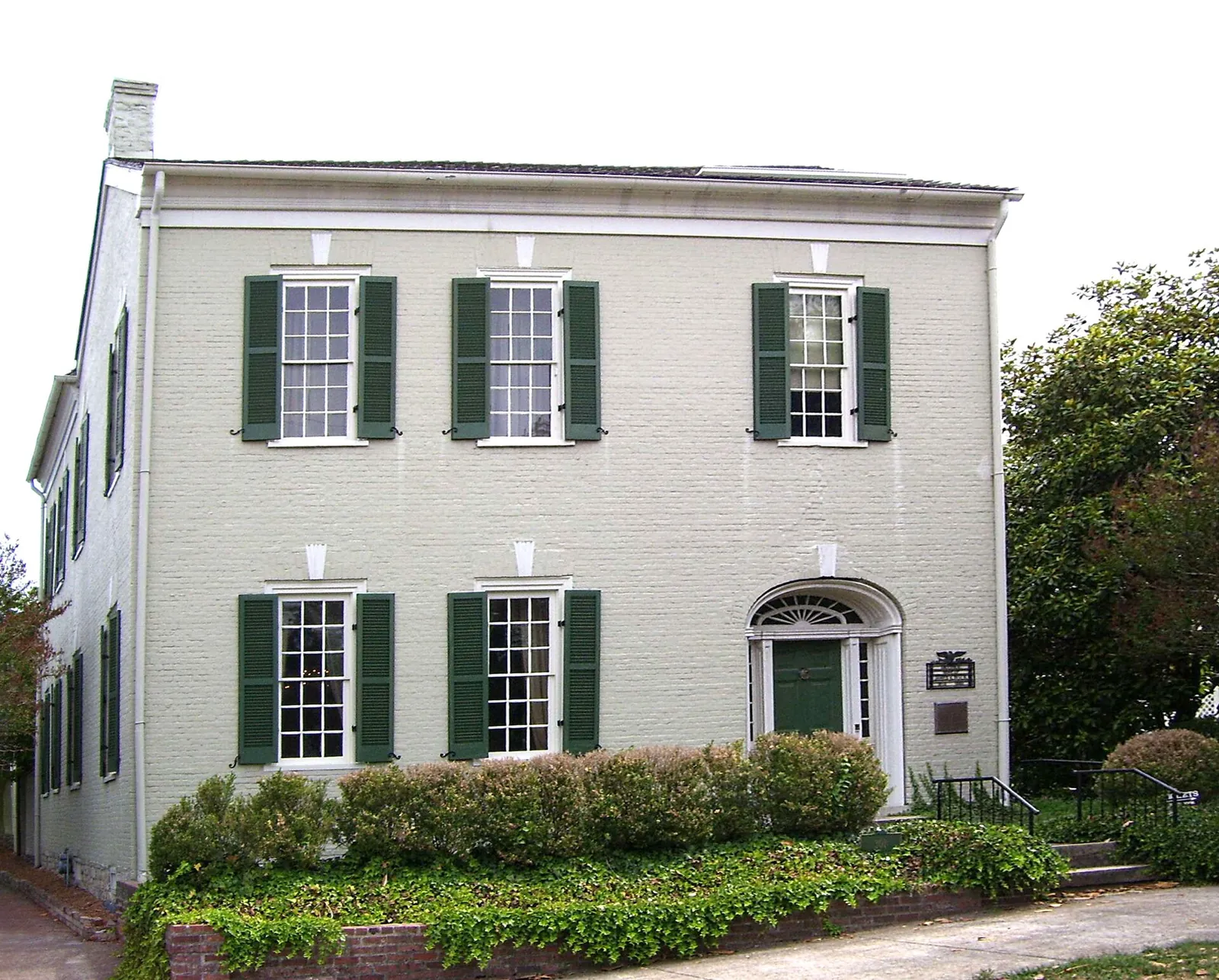 Then
The Polks also built big. South of town, in the Ashwood area, Polk brothers raised plantation houses and a small Gothic church, St. John's. Rattle and Snap, finished in 1845 for George Polk, is the grandest of them. In June 1936 a government photographer, W. Jeter Eason, came through with the Historic American Buildings Survey and recorded many of these places. His photos are some of the best early views of the county.
Columbia became a school town too. Jackson College, for men, organized in 1832, and the Columbia Female Institute was chartered in 1835. The house now known as the Athenaeum Rectory, begun about 1835 and finished in 1837 by the builder Nathan Vaught, became home to the Institute's head, the Rev. Franklin Gillette Smith. In 1852 Smith opened his own girls' school next door, the Athenaeum, which ran until 1904.
Who did the work
The wealth of these years rested on enslaved people. They cleared the fields, planted and picked the cotton, tended the stock, built many of the houses in these photographs, and ran the kitchens inside them. Their names are mostly missing from the deeds and the portraits.
By 1860 the census counted 32,498 people in Maury County. Of them, 14,654 were enslaved, about 45 percent of the whole county. Another 143 were free people of color. Even on single farms the numbers were large. At Rippavilla, near Spring Hill, Nathaniel Cheairs held more than 1,000 acres and 75 enslaved people, who lived in 15 dwellings on the place.
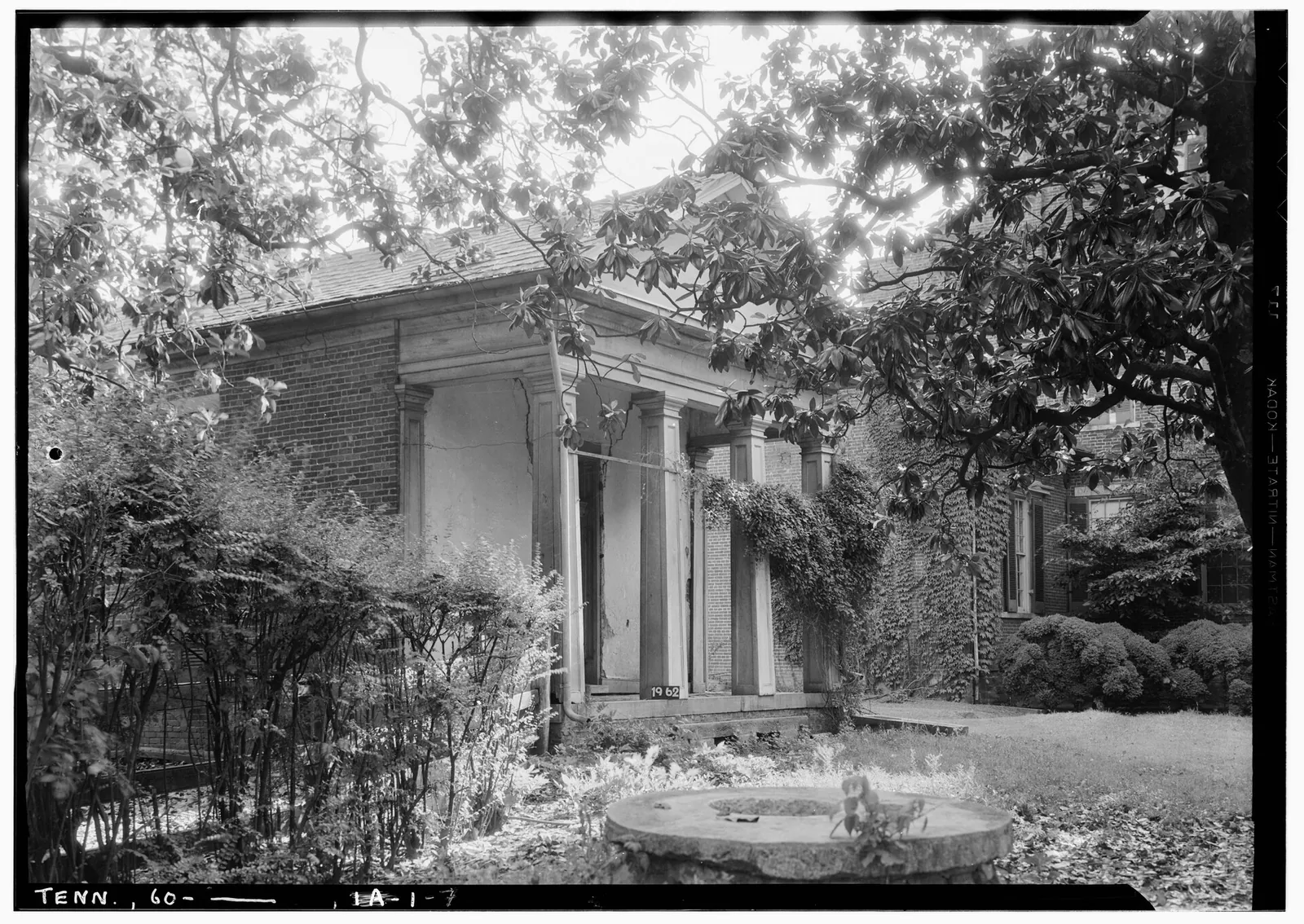
Black residents built their own institutions where they could. Hilltop Church, organized in 1838, is believed to be the first African American church in Columbia. In 1842 Edmund Kelly, an enslaved man, became the first African American ordained a minister in Tennessee.
The countryside around Knob Creek, a few miles north of town, was part of this same economy. The land chapter tells that story at the scale of one hollow.
The railroad arrives
On June 16, 1859, the first train of the Nashville and Decatur Railroad steamed into Columbia. The town now had a fast line north to Nashville and south toward Alabama. Two years later that same line, and the bridges that carried it over the Duck River, would make Columbia a place both armies wanted to hold.
- 1806The Polk family moves from North Carolina to Maury County.
- 1807The General Assembly creates Maury County on November 16.
- 1808Columbia is laid out and its first lots are sold. The town is four square blocks.
- 1816The Polk house on West 7th Street is built.
- 1817Columbia is incorporated.
- 1837The house now called the Athenaeum Rectory is finished.
- 1845James K. Polk, a Columbia lawyer, becomes the eleventh president.
- 1859The first train reaches Columbia on June 16.
- 1860The census counts 14,654 enslaved people in Maury County, about 45 percent of everyone there.