Chapter 07 of 091936 to 2000
Columbia changes
Chemical plants turned phosphate into paychecks. In February 1946 a fight in a downtown store became a night of terror in Mink Slide and a national civil rights case. Then came the interstate, a community college, and Saturn.
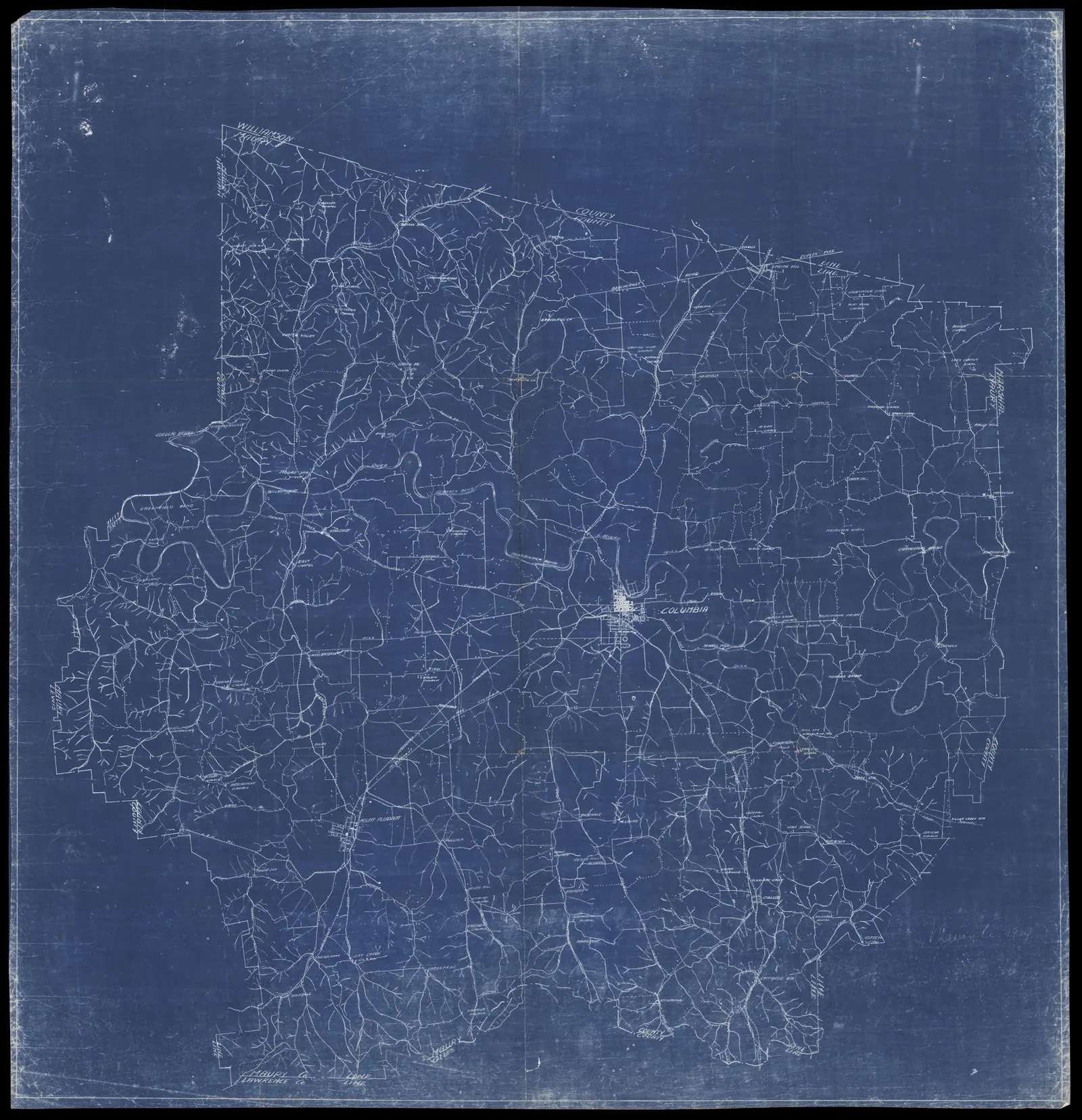
Maury County, Tennessee (blueprint map). Unknown · Tennessee State Library and Archives, Map Collection (TeVA) · 1924 · No copyright - United States (rightsstatements.org NoC-US, as assigned by TSLA)
In 1936, the year the Tennessee Valley Authority mapped the hollow on Knob Creek, Monsanto began building a plant near Columbia to turn Maury County phosphate into elemental phosphorus. The process needed huge electric furnaces, and TVA's new dams could supply the power. Victor Chemical Works opened a plant at Mount Pleasant in 1937, and TVA set up its own phosphate mining and washing operation at Columbia.
The plants changed what work looked like in the county. Men who had farmed or mined by hand now worked shifts at the furnaces. Another plant came in 1951, when Shea Chemical built a furnace in Columbia that later passed to Hooker and then Occidental. By 1971 three phosphorus plants in the county had a combined payroll of $15 million. Joe Hendley, who later owned the farm on Knob Creek, retired from Monsanto's Columbia plant. His story is in chapter 6.
February 1946
In early 1946 Columbia had about 5,000 white and 3,000 Black residents, and Black veterans were coming home from the war expecting to be treated as citizens. On February 25, James Stephenson, a 19-year-old Navy veteran, went with his mother, Gladys, to the Caster-Knott store downtown about a radio repair. A white employee threatened her. In the fight that followed, the employee went through a plate-glass window.
The Stephensons were arrested, fined, and then James was charged with assault with intent to murder. That night a white mob gathered at the courthouse. A block south, in Mink Slide, the Black business district along East 8th Street, Black men armed themselves to keep a lynching from happening, as one had in 1927. When four city policemen came into the dark street, they were shot and wounded.
Before dawn on February 26, state highway patrolmen under Safety Commissioner Lynn Bomar swept into Mink Slide. They fired into buildings, wrecked and looted businesses, and searched homes without warrants. More than 100 Black residents were arrested and about 300 guns seized. No one was allowed bail or a lawyer. On February 28, during questioning at the jail, officers shot and killed two prisoners, James Johnson and William Gordon, and wounded a third. A federal grand jury later cleared the officers.
The NAACP sent its chief lawyer, Thurgood Marshall, along with Walter White. Marshall worked with two Tennessee attorneys, Z. Alexander Looby of Nashville and Maurice Weaver of Chattanooga. Eleanor Roosevelt co-chaired a national committee to raise money for the defense. In the fall, 25 Black men were tried at Lawrenceburg, and 23 were acquitted. At a second trial in Columbia that November, one man was convicted.
Leaving Columbia after that trial, Marshall was stopped again and again by officers, arrested on a false drunk-driving charge and driven away from town. The charge was dropped at a magistrate's office.
The case drew national attention at a moment when the country was arguing about what returning Black veterans were owed. In December 1946 President Truman created the President's Committee on Civil Rights. Columbia was one of the cases that pushed him. In 2016 a state historical marker went up on East 8th Street, where Mink Slide stood.
- 1936Monsanto begins building an elemental phosphorus plant near Columbia.
- 1937Victor Chemical Works opens at Mount Pleasant.
- Feb 25, 1946A dispute at a downtown store leads to a white mob on the square and armed Black residents in Mink Slide.
- Feb 26, 1946State highway patrolmen sweep Mink Slide. More than 100 Black residents are arrested.
- Feb 28, 1946James Johnson and William Gordon are killed in the county jail.
- Oct 1946At Lawrenceburg, 23 of 25 Black defendants are acquitted.
- Dec 1946President Truman creates the President's Committee on Civil Rights.
- 1951Shea Chemical builds an electric furnace plant in Columbia, later Hooker and then Occidental.
- 1966Columbia State, Tennessee's first community college, holds its first classes. President Johnson dedicates the campus in 1967.
- 1969I-65's Highway 96 interchange at Franklin opens. Maury County schools are integrated.
- 1974Mule Day is revived.
- 1985On July 31, Governor Lamar Alexander announces Saturn will build at Spring Hill.
- 1986Monsanto begins shutting down its Columbia plant.
- 1990The first Saturn rolls off the line on July 30.
- 1991The Occidental and Rhone-Poulenc phosphorus plants close.
Roads, schools and Saturn
The postwar decades brought steady change. Columbia State Community College, the first community college in Tennessee, held its first classes in 1966, and President Lyndon Johnson came to dedicate the campus in 1967. Maury County integrated its schools in 1969. Interstate 65 was built down through Williamson and Maury counties in the late 1960s and early 1970s, putting Nashville within easy driving distance.
Mule Day faded in the 1950s and was revived in 1974. Columbia grew from about 10,600 people in 1940 to 26,600 in 1980.
Columbia, Spring Hill and Maury County, 1940 to 2000
Show the numbers
| Year | Columbia (city) | Spring Hill (city, Maury and Williamson) | Maury County |
|---|---|---|---|
| 1940 | 10,579 | 543 | 40,357 |
| 1950 | 10,911 | 541 | 40,368 |
| 1960 | 17,624 | 689 | 41,699 |
| 1970 | 21,471 | 685 | 43,376 |
| 1980 | 26,571 | 989 | 51,095 |
| 1990 | 28,583 | 1,464 | 54,812 |
| 2000 | 33,055 | 7,715 | 69,498 |
The phosphorus era ended as the century closed. Monsanto began shutting down its Columbia plant in 1986, and the Occidental and Rhone-Poulenc plants closed in 1991. The old Monsanto land, about five miles northwest of downtown, is now a state cleanup site.
Then, in July 1985, Governor Lamar Alexander announced that General Motors had picked Spring Hill, in the north end of the county, for its new Saturn car plant, over 37 other sites. The first Saturn rolled off the line on July 30, 1990. By 2001 the plant employed 7,800 people. Spring Hill, a crossroads of 1,464 people in 1990, had 7,715 by 2000, and the fields along the old pike where Hood's army camped in 1864 began to fill with subdivisions.