Chapter 04 of 091865 to 1935
Mules and phosphate
After the war, freed people built churches, schools and neighborhoods while white Tennessee built segregation. Columbia became the mule market of the South, and phosphate found near Knob Creek started a mining boom.
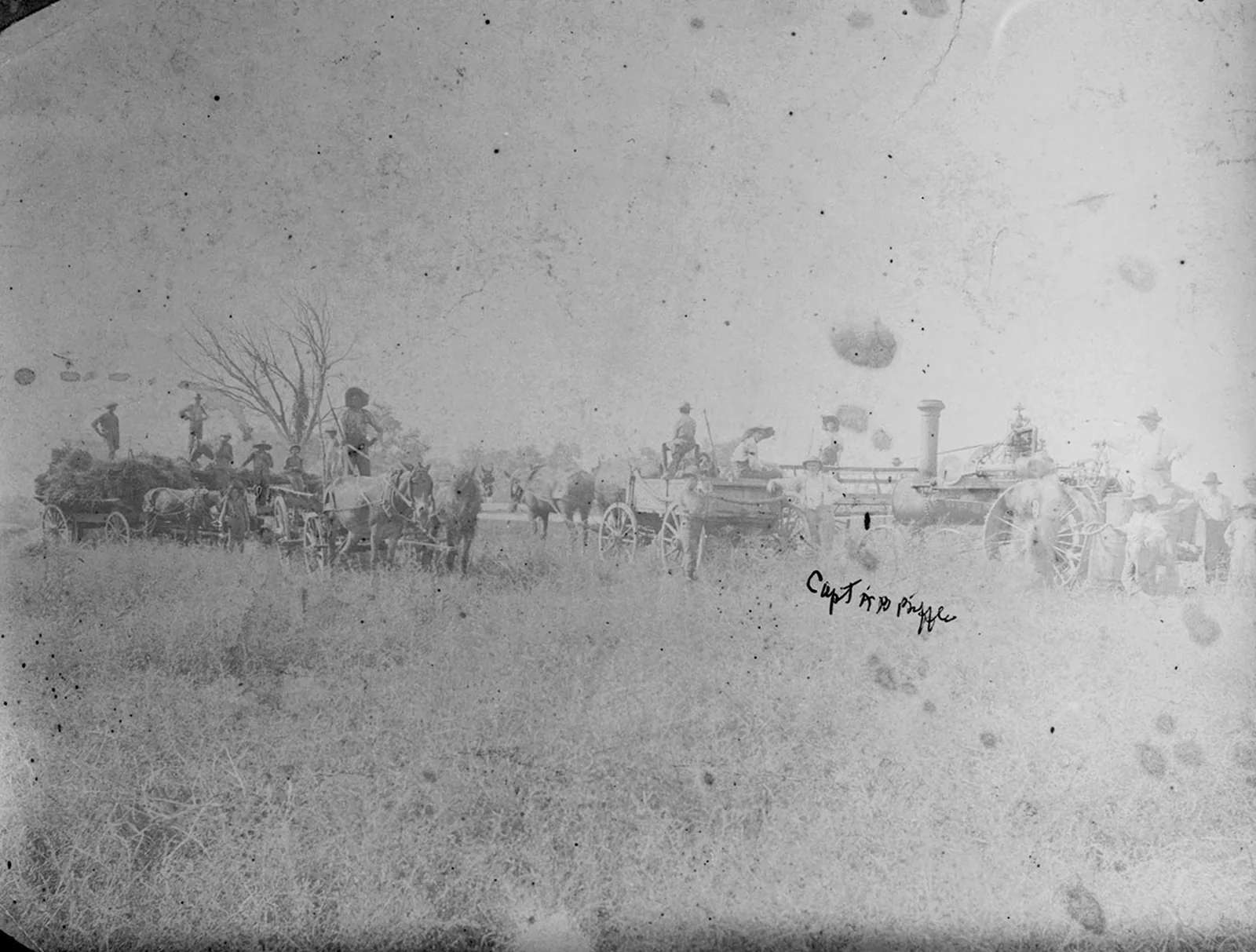
Threshing crew on the A.B. Biffle farm, Hampshire, Maury County. Unknown photographer · Tennessee State Library and Archives, Looking Back at Tennessee Photograph Collection, 1890-1981 (TeVA) · about 1897 · Public domain (created about 1900 or earlier by an unidentified photographer; U.S. copyright term has expired). TeVA rights field: Copyright not evaluated.
The war ended slavery in Maury County, and freed people moved fast to build lives of their own. In 1865 nine Freedmen's Bureau schools opened in Columbia and the county. Black families founded churches and bought what land they could. Some stayed on the old places as wage hands and sharecroppers. At Rippavilla, near Spring Hill, a freedmen's community called the Cheairs Quarters grew up on the land where its residents or their parents had been enslaved.
For a short time, the vote seemed within reach. In 1867, the year Black men in Tennessee could first vote, about 1,000 members of the Union League marched to the Columbia courthouse to cast ballots. In Franklin that July, a Union League rally ended with armed white Conservatives firing into the marchers on the square. One white man was killed and many Black men were wounded, most of them shot in the back or the legs.
The backlash won. By the 1880s Columbia had segregated public schools, and over the next decades Jim Crow law and custom closed off most of what Reconstruction had opened. Rosemount Cemetery, founded in 1873, holds many of the Black families who lived through those years.
- 1865Nine Freedmen's Bureau schools open in Columbia and Maury County.
- 1867About 1,000 Black Union League members march to the Columbia courthouse to vote. In Franklin, a Union League rally on July 6 ends in gunfire on the square.
- 1873Rosemount Cemetery, Columbia's largest Black cemetery, is established.
- 1880Segregated public schools open in Columbia.
- 1886Stonecutter William Shirley finds phosphate on Gholston Hill near Columbia.
- 1891Shirley finds blue phosphate rock around Knob Creek, north of Columbia.
- 1895-96High-grade brown phosphate is found near Mount Pleasant. The boom begins.
- 1903Union Station opens in Columbia, by most accounts.
- 1904-06The present Maury County Courthouse is built.
- 1905Columbia Military Academy opens in the old federal arsenal.
- 1927Henry Choate, 18, is lynched at the courthouse in November.
- 1934The first Mule Day parade. Tom Brown is grand marshal.
Violence enforced the line. In November 1927 a mob took Henry Choate, an 18-year-old Black man accused of assaulting a white girl, from the county jail, dragged him behind a car and hanged him at the courthouse. A grand jury declined to charge anyone. It was one of two lynchings in the county after 1925. Those years sit behind what happened in Columbia in 1946.
Mule town
The land stayed rich, and after the war Maury farmers moved from cotton toward grain, tobacco and livestock. One kind of livestock made Columbia famous. Mules, tough and sure-footed, pulled the plows of the South, and Columbia became one of the biggest mule markets anywhere.
Since the 1840s, breeders had gathered on the courthouse square on the first Monday in April to show and trade their stock. Townspeople called it Breeders' Day. In 1934 the town turned it into a festival with a parade, led by grand marshal Tom Brown, and named it Mule Day. Columbia started calling itself the Mule Capital of the World.
The Tennessee Valley Authority sent a photographer to Mule Day in 1939. The pictures show the square packed with wagons and people, mules lined up under the courthouse columns, and shoppers outside Woolworth's. By then tractors were coming, and the mule trade was near its peak.
Rock under the fields
The other thing under Maury County was phosphate, a rock that makes fertilizer. In 1886 a stonecutter named William Shirley noticed it on Gholston Hill near Columbia, but the deposit was too small to mine. In 1891 he found blue phosphate rock around Knob Creek, north of town. That is the creek the farm is named for. A company formed, and in 1892 two tons were shipped to Nashville.
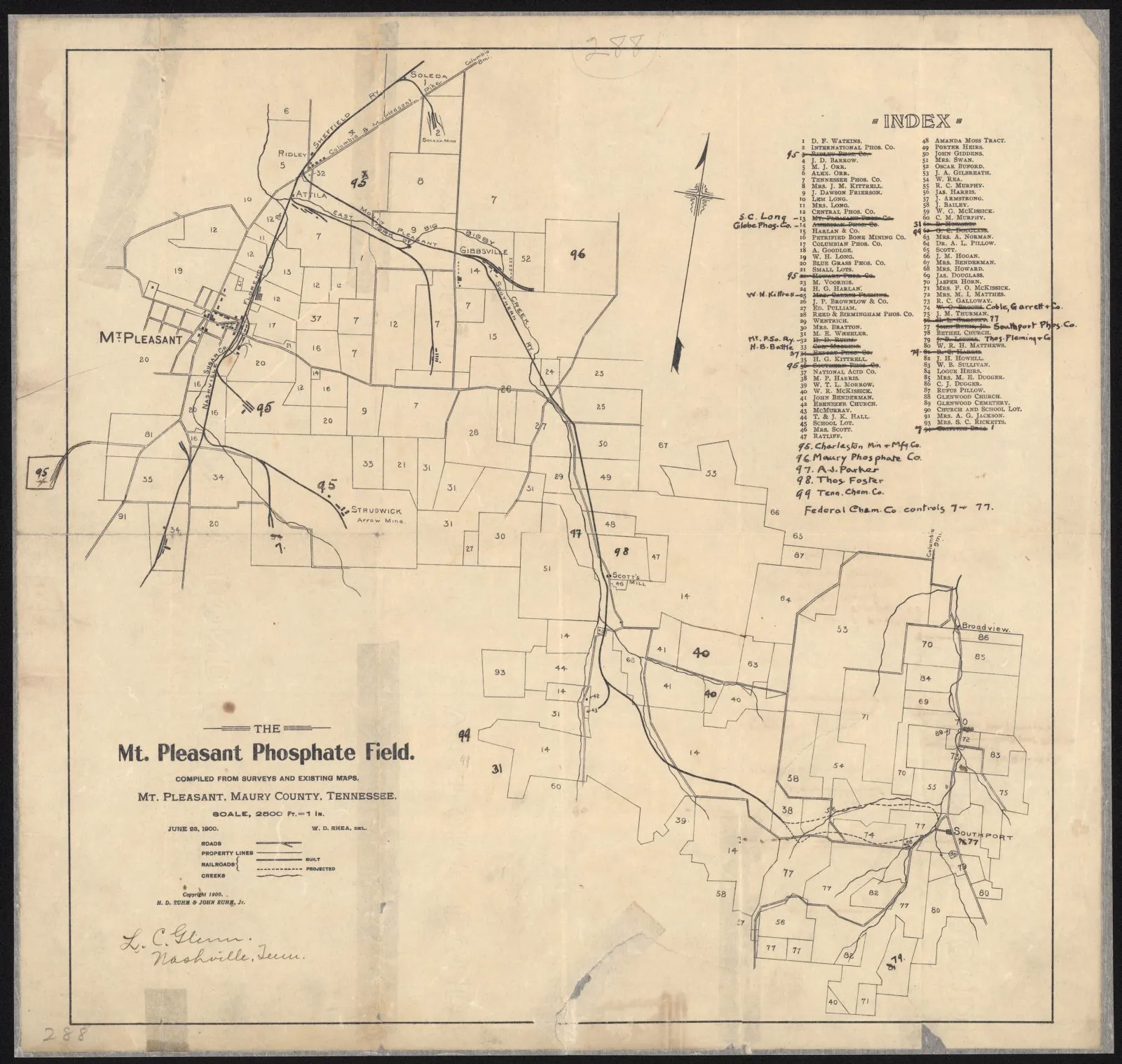
The real boom came a few years later, when high-grade brown phosphate turned up near Mount Pleasant, south of Columbia, in 1895 or 1896. Mount Pleasant grew from 466 people in 1890 to about 2,000 in 1900, and fifteen mining companies were working around it in the early 1900s. Strip mines opened across the southern part of the county, and the rail lines carried the rock away.
Columbia changed with all of it. The old courthouse was razed in 1903 and the present one built in 1904 to 1906. Union Station opened on the railroad around 1903. In 1905 the abandoned federal arsenal on the edge of town became Columbia Military Academy.
Yet the county as a whole was losing people. Maury had about 42,700 residents in 1900 and about 34,000 in 1930, as families left worn-out farms for cities in the North and the growing towns of the South. Many of those who left were most likely Black families joining the Great Migration north; the county census tables by race would confirm it. Columbia itself grew slowly, to about 7,900 by 1930.
Columbia grew while the county shrank, 1900 to 1940
Show the numbers
| Year | Columbia (city) | Maury County |
|---|---|---|
| 1900 | 6,052 | 42,703 |
| 1910 | 5,754 | 40,456 |
| 1920 | 5,526 | 35,403 |
| 1930 | 7,882 | 34,016 |
| 1940 | 10,579 | 40,357 |
By the mid-1930s the stage was set for the next change. Phosphate, cheap electric power from the new Tennessee Valley Authority, and a railroad town full of people looking for work would bring the chemical plants.